
How Drama Classes Help Children Build Confidence, Communication and Life Skills

Many parents begin looking for drama classes because they hope their child will become more confident.
Perhaps their child is shy when speaking in class. Perhaps they struggle to express themselves during presentations or feel nervous when meeting new people. Others simply enjoy storytelling, performing or using their imagination and want an opportunity to develop those interests further.
Confidence is often the first goal parents mention.
Ironically, it is rarely the first thing children develop.
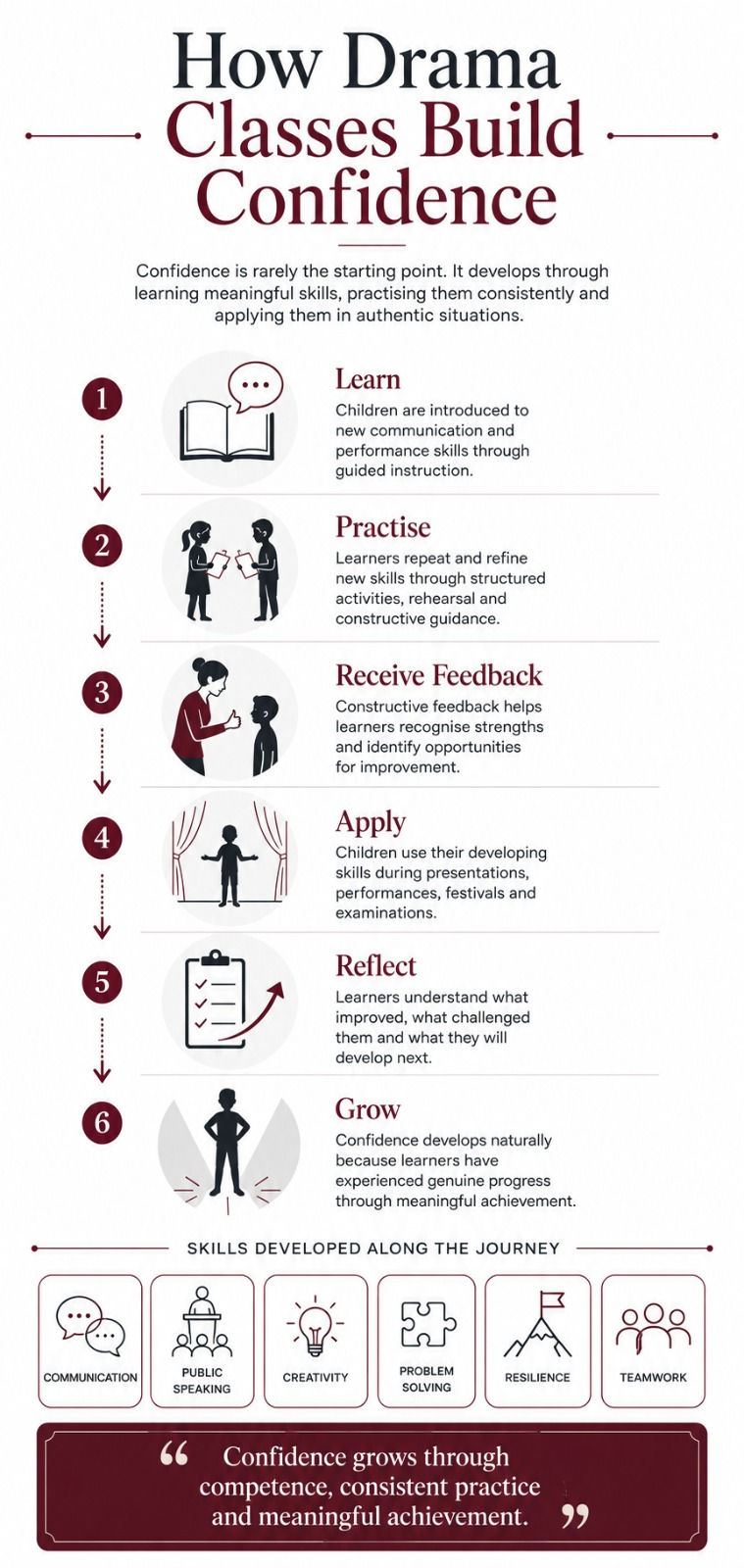
At Praxis Dramatic Arts Academy, we believe confidence is usually the result of learning meaningful skills rather than the starting point of the learning journey. Children rarely become confident before they become capable. Instead, they gradually develop confidence as they discover they can communicate clearly, solve problems, work with others and overcome challenges through guided practice and experience.
This philosophy shapes every aspect of our programme and reflects a simple educational principle: meaningful confidence is built through meaningful achievement.
Drama Is About More Than Acting
One of the biggest misconceptions about dramatic arts is that it is simply about acting on stage.
Performance certainly forms part of drama education, but quality programmes teach far more than memorising lines or standing in front of an audience.
Children learn how to communicate ideas clearly.
They learn how to listen with intention, respond thoughtfully and work collaboratively with others.
They develop creativity by exploring different perspectives and solving problems in imaginative ways.
They learn resilience by receiving constructive feedback and using it to improve rather than becoming discouraged.
Perhaps most importantly, they learn that progress is something they earn through practice rather than something they are expected to achieve immediately.
These are skills that extend far beyond the performance space.
Whether a child eventually becomes a teacher, engineer, scientist, entrepreneur or artist, the ability to communicate effectively, think creatively and respond confidently to unfamiliar situations remains valuable throughout life.
Confidence Is Built Through Competence
Parents naturally want their children to believe in themselves. Encouragement plays an important role in that process. Children benefit enormously from knowing that their parents and teachers support them. However, encouragement alone rarely creates lasting confidence. Imagine a child learning to ride a bicycle. You can reassure them. You can tell them they are capable. You can encourage them every step of the way. Yet genuine confidence usually appears only after they have practised balancing, steering and pedalling enough times to ride independently. The same principle applies to communication. Children become confident speakers by speaking. They become confident readers by reading. They become confident performers by performing. Every successful experience becomes evidence that they are capable of doing something they could not previously do.
Educational psychologist Albert Bandura described these successful learning experiences as mastery experiences, recognising them as one of the strongest contributors to developing self-efficacy, or a person's belief in their own ability to succeed. For parents, this means confidence should not be viewed as something we simply try to build directly. Instead, we should focus on helping children develop the skills that naturally allow confidence to emerge.
Why Structured Learning Matters
Not every drama programme follows the same educational philosophy. Some focus primarily on preparing learners for productions.
Others emphasise games and recreational participation as a mechanism.
While both approaches have value, structured dramatic arts education takes a broader view of child development.
At Praxis Dramatic Arts Academy, learning follows a progressive pathway where each new skill builds upon previous learning.
Children are not expected to perform complex tasks immediately.
Instead, they develop strong foundations before moving towards increasingly challenging activities.
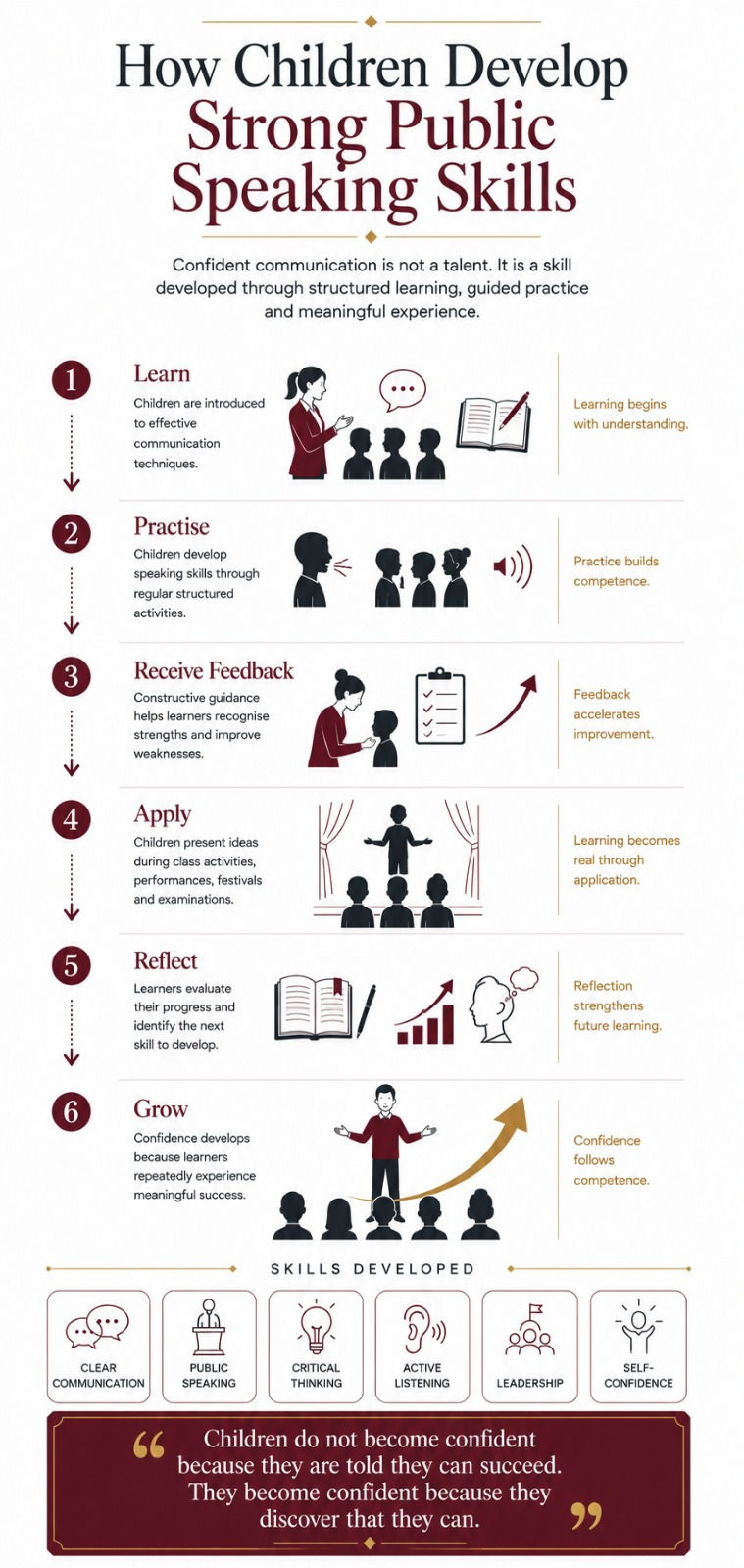
Communication skills develop through repeated opportunities to speak and present ideas.
Performance skills develop through guided practice, rehearsal and constructive feedback.
Confidence develops as learners begin recognising their own progress.
This gradual progression allows children to experience genuine achievement rather than being overwhelmed by expectations beyond their current level of readiness.
Every learner develops differently.
Some naturally enjoy performing from their very first lesson.
Others require more time before feeling comfortable participating in front of others.
Neither approach is better.
Good teaching recognises where each learner currently stands and helps them take the next appropriate step forward.
That is why meaningful progress is far more important than perfection.
The Importance of Feedback
Many children associate feedback with criticism.
In reality, constructive feedback is one of the most valuable parts of learning.
Feedback helps learners understand what they are already doing well while identifying clear opportunities for improvement.
Instead of wondering whether they are making progress, children receive practical guidance that helps them continue developing.
At Praxis Dramatic Arts Academy, feedback forms an important part of the learning process because improvement depends on reflection as much as participation. Learners are encouraged to recognise their strengths, understand where further growth is possible and approach each new challenge with curiosity rather than fear. This philosophy helps create an environment where mistakes are viewed as part of learning instead of something to avoid.
Children who understand that mistakes are a normal part of learning often become more willing to attempt difficult tasks because success is no longer measured by perfection alone.
Instead, success becomes measured by progress.
How Drama Classes Prepare Children for Real Life
One of the strengths of dramatic arts is that the learning does not remain inside the studio.
Every lesson provides opportunities for children to apply their developing skills in situations that require preparation, communication and problem solving.
They learn to organise their thoughts before speaking.
They learn to adapt when something does not go according to plan.
They learn to work with different personalities and contribute towards a shared outcome.
These experiences mirror many of the situations children encounter throughout school and later in adult life.
Giving a class presentation.
Participating in a group project.
Introducing themselves to new people.
Attending an interview.
Leading a discussion.
Although these situations may look very different from a drama lesson, they often rely on the same underlying skills.
For this reason, dramatic arts should not be viewed simply as preparation for the stage. It is preparation for communication, collaboration and lifelong learning.
Performance Is an Extension of Learning
Many parents feel nervous when they hear words such as competition, assessment or performance.
They worry that these experiences may place unnecessary pressure on children.
Our educational philosophy approaches these opportunities differently.
At Praxis Dramatic Arts Academy, performances, external festivals and examinations are not viewed as isolated events or measures of a child's worth. They are viewed as opportunities for learners to apply the skills they have been developing throughout their training. They provide authentic experiences that help children understand what they have mastered and what they can continue improving.
This distinction is important.
When performance becomes the only objective, children may begin fearing mistakes.
When performance becomes part of the learning process, mistakes become valuable information that supports future growth.
Children begin to understand that learning is continuous.
Every experience contributes to their development.
Choosing the Right Drama Programme
If you are considering drama classes for your child, it is worth asking a few important questions before enrolling.
Does the programme have a clear educational philosophy?
Are learners taught progressively rather than simply preparing for performances?
Is constructive feedback part of the learning process?
Does the programme develop communication, creativity and personal growth alongside performance skills?
Are external performances and examinations used to support learning rather than define success?
These questions help distinguish structured educational programmes from recreational activities.
Neither approach is necessarily wrong.
However, parents should choose the programme that best matches the outcomes they hope their child will achieve.
Why Parents Choose Praxis Dramatic Arts Academy
At Praxis, dramatic arts is approached as a structured educational discipline rather than simply an extracurricular activity.
Every learner follows a progressive pathway designed to develop practical skills through guided instruction, purposeful practice and meaningful performance experiences.
Our aim is not simply to help children perform confidently on a stage.
Our aim is to help them become thoughtful communicators, resilient learners and capable young people who can apply their skills wherever life takes them.
We believe confidence is not something that should be promised.
It is something children gradually earn as they experience genuine progress.
That is why our teaching focuses on developing competence first.
Confidence follows naturally.
Final Thoughts
Parents often begin searching for drama classes because they hope their child will become more confident.
Confidence is certainly an important outcome.
However, it is rarely the first outcome.
Children first learn how to communicate.
They learn how to listen.
They learn how to think creatively.
They learn how to work with others.
They learn how to respond to challenges.
As these skills develop through consistent practice, guided feedback and meaningful achievement, confidence begins to grow alongside them.
That is why quality dramatic arts education offers benefits that extend far beyond acting.
It helps prepare children not only for performances, but for presentations, interviews, leadership opportunities, relationships and many of the situations they will encounter throughout life.
At Praxis, this belief shapes every lesson we teach.
Because we believe the goal is not simply to help children perform.
The goal is to help them develop the skills that allow them to thrive.
Frequently Asked Questions
Are drama classes only for children who want to become actors?
No. Most children develop communication, confidence, creativity, teamwork and public speaking skills that are valuable regardless of their future career interests.
Can drama classes help shy children?
Many shy children become more comfortable expressing themselves through gradual, structured participation. Progress varies between individuals, and quality programmes respect each child's pace of development rather than forcing participation.
What age is best to start drama classes?
Different programmes serve different age groups. The most important consideration is choosing a programme with structured teaching, age-appropriate expectations and clear educational goals.
Do drama classes help with school?
Drama can support skills that are valuable in school, including oral presentations, communication, collaboration, creative thinking and self-confidence. These skills complement classroom learning rather than replacing it.
Sources and Further Reading
● Self-Efficacy: The Exercise of Control
● Self-efficacy: Toward a Unifying Theory of Behavioral Change
● The Arts and the Creation of Mind
Continue Your Parent Resource Journey
Choosing the right dramatic arts programme begins with understanding how children learn and develop. Explore our other Parent Resources to learn more about confidence, communication, creativity and the educational principles that guide Praxis Academy.
Ready to learn more about Praxis Academy? Visit our Programme page or contact us to discover how our structured dramatic arts training helps children develop skills that extend far beyond the stage.
Continue Reading
● Can Drama Classes Help a Shy Child?
● What Happens During a Drama Class?
● How Parents Can Support Their Child's Confidence at Home

Comments